When the Map No Longer Matches the Territory: A Christian's Guide to Revising Inherited Belief

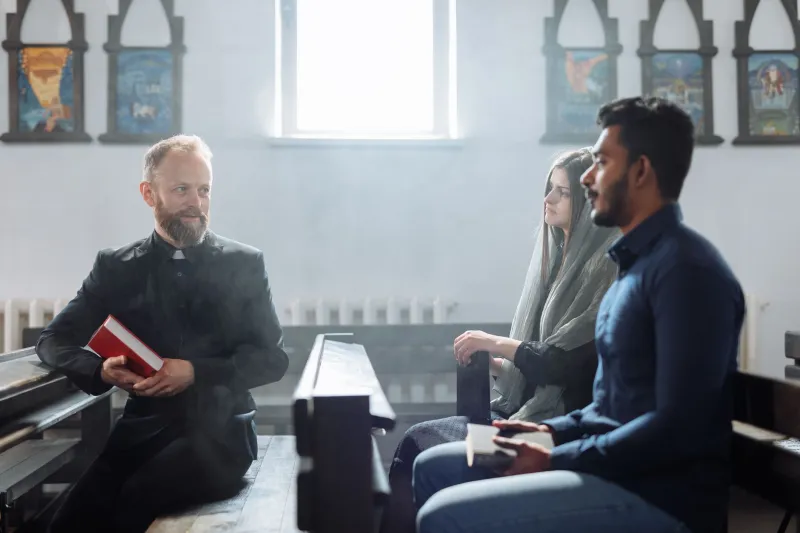
Photo: Ben White benwhitephotography, CC0, via Wikimedia Commons
There is a particular kind of spiritual vertigo that arrives not in the wilderness of unbelief but in the center of sincere faith. It is the moment a devoted believer — someone who has prayed faithfully, served diligently, and held tightly to the convictions passed down through family and tradition — opens Scripture and finds that the text no longer says quite what they were taught it said. The map, in other words, no longer matches the territory.
This experience is more common in Central Florida congregations than many church leaders openly acknowledge. And yet the silence around it may be costing the Church dearly — driving sincere questioners into isolation precisely when they most need the community of believers to walk alongside them.
The Inheritance We Did Not Choose
Faith, for most American Christians, begins as an inheritance. Long before a child can engage in critical theological reflection, she has already absorbed a comprehensive worldview — assumptions about God's character, the nature of Scripture, the boundaries of salvation, the proper ordering of family and society. These early impressions are not liabilities. They are gifts. They provide a foundation upon which genuine faith can be built.
The complication arises when that inherited framework, however lovingly constructed, was shaped as much by cultural Christianity and family tradition as by careful biblical exegesis. A man raised in a tradition that conflated patriotism with piety may reach adulthood and discover that his nationalism and his theology have become so entangled that he cannot easily distinguish one from the other. A woman formed in a church culture that treated certain socioeconomic assumptions as scriptural imperatives may encounter the Sermon on the Mount one morning and feel the ground shift beneath her.
This is not apostasy. In many cases, it is the beginning of a more mature and more honest faith.
Biblical Precedents for Belief Transformation
The discomfort of revising inherited conviction is ancient. Scripture itself is populated with figures whose encounters with God required them to abandon deeply held assumptions.
Peter, one of the most prominent voices in the early Church, carried a theological inheritance that drew a firm boundary between the clean and the unclean — between the people of God and those outside the covenant. In Acts 10, God confronted that inheritance directly. Through a vision and a subsequent encounter with the Gentile Cornelius, Peter arrived at a conclusion that would have been unthinkable within his received framework: God shows no partiality. His words to Cornelius's household — "Truly I understand that God shows no partiality" (Acts 10:34, ESV) — represent not an abandonment of Scripture but a deeper, Spirit-led reading of it.
Paul's transformation is perhaps the most dramatic in the New Testament. A man whose inherited zeal had led him to sanction violence against the Church encountered the risen Christ and found that his entire theological map required reconstruction. He did not discard his formation in the Law; he reinterpreted it through the lens of the crucified and risen Messiah. The result was not a faith untethered from tradition but one that had been brought into more faithful alignment with the God tradition was always meant to reveal.
These are not cautionary tales about the dangers of certainty. They are testimonies to the Spirit's ongoing work of drawing believers into greater faithfulness — even when that work requires the painful revision of what we thought we knew.
Voices From Orlando's Congregations
In conversations with believers across the greater Orlando area, a recurring pattern emerges: the revision of inherited belief rarely arrives as a sudden rupture. More often, it unfolds gradually — through sustained engagement with Scripture, through relationships with believers whose experiences differ sharply from one's own, and through the quiet, persistent prompting of the Holy Spirit.
One longtime member of a Central Florida congregation described a years-long journey of reconsidering views on poverty and personal responsibility that had been instilled through his upbringing. "I was taught that financial struggle was almost always the result of poor choices," he recalled. "That seemed to fit with a certain reading of Proverbs. But the more I read the Prophets — Amos, Isaiah, Micah — the harder it became to hold that position without qualification. These weren't abstract theological texts. They were indictments. And they forced me to ask whether I had been reading Scripture selectively."
A woman who has attended her church for over two decades described a similar reckoning, this one centered on questions of racial reconciliation. "I grew up being told that talking about race in church was 'divisive' and 'political.'" She paused. "But then I started reading about the history of the Church in America — not to be antagonistic, just to understand — and I realized that silence on these questions was itself a position. And it wasn't a position I could defend from Scripture."
Neither of these individuals left the Church. Neither described their journey as a loss of faith. Both used the word deepening.
The Church's Responsibility: Creating Space Without Abandoning Roots
For pastors and ministry leaders, the challenge is significant. A congregation that never questions its inherited assumptions risks calcifying into cultural Christianity — a faith that mirrors its surrounding culture more than it reflects the character of Christ. But a congregation that treats all inherited conviction as suspect risks untethering itself from the very tradition that provides coherence, accountability, and rootedness.
The answer is not to choose between intellectual honesty and doctrinal faithfulness. It is to insist that genuine faithfulness requires intellectual honesty.
Several practical postures can help local churches create the conditions for this sacred work:
Normalize the questions before they become crises. When churches treat theological questioning as an early warning sign of spiritual defection, they ensure that sincere questioners go underground — or go elsewhere. Preaching that models honest engagement with difficult texts, and small group environments where uncertainty can be voiced without social penalty, are among the most effective tools available.
Distinguish between the non-negotiable and the inherited. Not every conviction carries equal weight. The resurrection of Jesus Christ is not in the same category as a particular political alignment or a specific view of end-times chronology. Churches that help their members develop this kind of theological discernment do them an enormous service.
Honor the tradition even as you examine it. Revision need not mean rejection. Believers who are revising inherited convictions can do so with gratitude for the community that formed them, even when they can no longer follow that community's conclusions in every particular. Churches that model this posture — holding tradition with both appreciation and honest scrutiny — give their members permission to do the same.
Anchor the process in Scripture and prayer. The goal of theological revision is not intellectual sophistication for its own sake. It is greater conformity to Christ. That work is done on one's knees as much as at one's desk.
The Courage Faithfulness Requires
Revising a deeply held conviction is not an act of weakness. In many cases, it is among the most courageous things a believer can do — particularly when that revision places them at odds with the community that first shaped them. The temptation to maintain inherited positions for the sake of relational peace or cultural belonging is real and persistent.
But the God who met Peter in a vision, who arrested Paul on the road to Damascus, and who continues to speak through His Word to believers in Orlando and across this nation is not threatened by honest questions. He invites them. The faith that endures is not the faith that was never examined. It is the faith that was examined, tested, and found — through the grace of God — to be more expansive, more merciful, and more true than it first appeared.
At Central Christian Doc Orlando, we believe that kind of faith is worth pursuing — together, with humility, and without fear.